
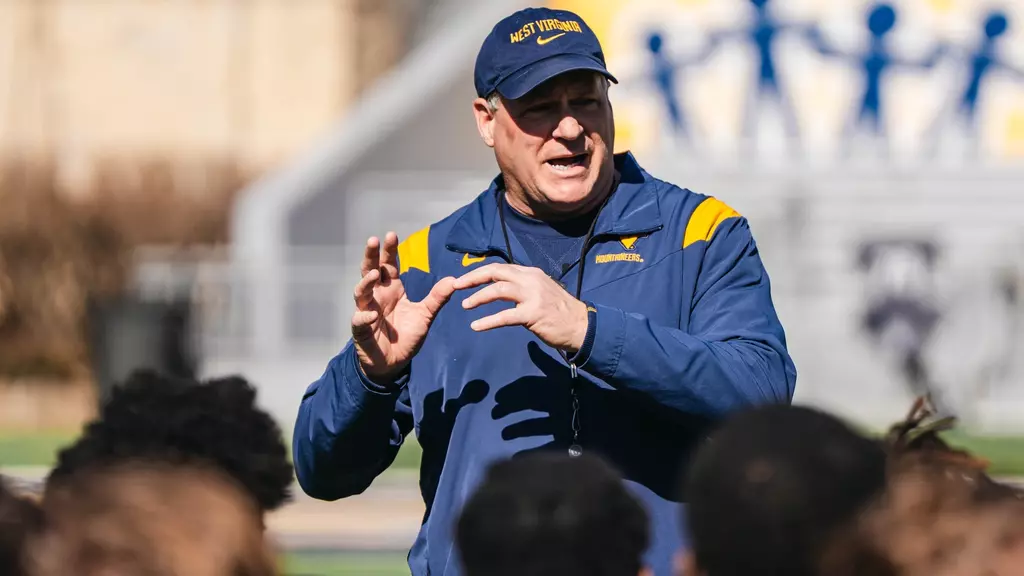
Since West Virginia announced the hiring of Rich Rodriguez back in December, there’s been a renewed sense of optimism among fans and alumni. Mountaineer Nation is hoping for a return to the glory days when WVU was a fixture in the national spotlight and winning BCS bowl games. After six disappointing seasons under Neal Brown, it feels like time to turn the page. READ MORE: Can Rich Rodriguez’s Power Spread Reignite WVU Football?
Of course, expectations for a dramatic turnaround in Year One should be tempered. National media outlets have largely picked WVU to finish near the bottom of the Big 12, and from the outside looking in, that makes sense. This is a team in a Power Four conference undergoing major changes to both its roster and coaching staff.
But despite that, there’s a growing belief, especially among those close to the program, that success might come sooner than expected. Why? It’s not just the catchy return of the “Hard Edge” slogan, though that mindset will matter. The real reason for hope is Rich Rodriguez’s offense.
Power Spread
Thirty-five years after first developing it at Glenville State, Rodriguez’s power spread system remains one of the most effective and forward-thinking schemes in college football. Once seen as revolutionary, his offense has taken on a near-mythical status. The offense is misunderstood by some, mimicked by many, and still dangerous when run the right way. But what is the power spread, really? And why might it give West Virginia a real edge in 2025?
“When we first started doing it…we wanted to get in the two‑minute drill the whole game,” explained Rodriguez. “It took off…and we had great time with it…our whole philosophy [was] make them defend in space and create some conflicts for them”
In today’s game, it’s rare for an offensive system to truly reshape the landscape. In the late ’70s and into ’80s, coaches like Mouse Davis helped usher in the Run-and-Shoot, breaking away from the three-yards-and-a-cloud-of-dust mentality.
Spread concepts exploded in the early 2000s and quickly became the norm. Now, nearly every major college program incorporates spread elements. Meanwhile, schemes like the wishbone and triple option have faded into novelty—great for the Army-Navy game, but relics in today’s high-speed era.
So what makes Rich Rod’s offense different?
Related: WVU’s Quarterback Battle: Who Will Win the Starting Job?
Hard Edge
First, it demands a certain type of player: tough, conditioned, and relentless. When this coaching staff talks about a “Hard Edge,” they’re not just recycling a phrase. They’re describing the attitude and preparation needed to run a tempo-heavy, run-focused offense that wears down defenses and exploits numbers advantages on the ground.
“The core of what we’re doing, the tempo part of it, I still think is non‑negotiable…The most overlooked factor in football is conditioning, and we want to make it a factor in every game,” Rodriguez told The Triple Option podcast.
Second, it’s the structure. Rodriguez’s power spread isn’t just about tempo and read-option. It’s about leveraging every inch of the field, and every skill player in a precise role. While he prefers every receiver know each position, his designations (X, Y, H, and Z) aren’t interchangeable. They each serve a specific purpose:
- X Receiver – Usually lined up on the backside of the formation, the X is your go-to playmaker, often isolated in one-on-one matchups. This position requires size, strength, and route-running precision. Think of someone who can win on slants, fades, and back-shoulder throws.
- Z Receiver – Typically lined up opposite the X, often on the strong side. The Z must be versatile. They must be able to block in the run game, run deep routes, or work underneath. Quickness and football IQ are key here, especially when reading coverages on the fly.
- H Receiver – This is the slot receiver, and in Rodriguez’s system, arguably the most dynamic weapon. The H is used in motion, jet sweeps, bubble screens, and quick option routes to stretch the defense horizontally. Think of this spot as a hybrid slot/running back—someone with elite short-area quickness.
- Y Receiver – Often aligned as a tight end or H-back depending on formation, the Y is critical in the run game but also used in short passing concepts like pop passes, flats, or seam routes. It’s a position that can exploit mismatches with linebackers or safeties.
This structure allows Rodriguez to adjust formations without changing personnel, keeping defenses off-balance. Combine that with a zone-read run game and tempo that rarely lets defenders substitute, and you’ve got a nightmare for even the best-coached units.
Run-First Mentality
Even in the offensively minded Big 12, Rodriguez’s spread offense jumps off the screen. While many Big 12 defenses gear up to stop traditional air raid schemes or balanced modern spreads, Rich Rod flips the script. His offense pounds teams with a relentless run game, keeps the tempo scorching, and punishes defenses through the air once they’re worn down or caught out of position.
Yes, Rodriguez may not yet have his players fully in place. And yes, the transfer portal era makes building long-term systems more complicated. But if this team can buy in quickly – and all signs from spring practice suggest they’re doing just that – then West Virginia might not be rebuilding for long.
The Mountaineers have a lot to prove. But don’t be surprised if it’s Rodriguez’s power spread offense that sets the tone for a quicker-than-expected return to relevance.
I hope he does better than he has at the schools that dropped him.
Well, that would just be Michigan. I think he’s long past that.