
During West Virginia University’s unforgettable run to Omaha during the Men’s College World Series, John Denver’s “Take Me Home, Country Roads” seemed to be everywhere.
After the Mountaineers defeated Kentucky in the Morgantown Regional, ESPN2 did something television rarely allows anymore – it simply let the moment breathe. As the broadcast lingered on Kendrick Family Ballpark, fans, players and coaches locked arms and sang every word in unison. The cameras rolled. The crowd swayed. And a national audience witnessed something Mountaineer fans and alumni have known for more than 50 years: “Country Roads” is more than a song. It’s a tradition. It’s a celebration. It’s part of West Virginia’s identity. Read more: The road leads home: How “Country Roads” became part of WVU
That moment quickly went viral, but it was only the beginning.
Related: Omaha reflections: covering WVU’s historic CWS run
NBC Nightly News featured it in its “Good News Tonight” segment, showcasing thousands of fans singing together in Morgantown. Days later, the song echoed on an entirely different stage as the U.S. Men’s National Team celebrated victories by blasting “Country Roads” through the stadium and locker room. Midfielder Tyler Adams spoke about what the song meant to the team, while coach Mauricio Pochettino joked that listening to it made him feel “really American.”
For a few weeks, one of the most recognizable songs in America reminded the rest of the country why it has become inseparable from West Virginia.
Which, naturally, meant it was time for somebody to explain why we weren’t supposed to enjoy it.
Don’t dull our shine
It never fails.
The moment “Country Roads” enjoys another moment in the national spotlight, the self-appointed fact-checkers come marching in. Sure, a healthy percentage of them seem to wear Pitt blue and gold or Marshall green, but they’re hardly alone. What begins as a joyful, unifying celebration after a WVU victory somehow turns into a geography lesson.
“If you know the Blue Ridge Mountains are in Virginia…”
“The Shenandoah River isn’t really in West Virginia…”
I’ve heard it all. If I have to sit through one more lecture about the song’s geography, I may lose my mind.
West Virginia singer-songwriter Charles Wesley Godwin recently voiced what many Mountaineer fans have been thinking for years during a podcast appearance promoting his latest music:
“Every time, man. And inevitably, there’s always that person that’s like, ‘You know, the song is about Virginia or about western Virginia.’ Those people drive me f***ing nuts. It’s the smuggest, most annoying thing ever (when they say), ‘It’s about Virginia actually.’ If you’re coming from D.C., swing through Harper’s Ferry and tell me it’s about Virginia, not West Virginia, it drives me nuts… It’s about West Virginia.”
For years, I’ve defended the song every chance I got. But after digging into its history, I’ve come to a different conclusion. The critics get some of the history right. They just stop telling the story too soon.
Meant to be
Like many great songs, “Take Me Home, Country Roads” wasn’t born in one place. It came together through a series of moments that, in hindsight, almost seem destined.
The story begins not in West Virginia, but on a drive through rural Maryland. Songwriters Bill Danoff and Taffy Nivert were traveling along Clopper Road when the phrase “country roads” began to take shape. Danoff later said the scenery reminded him of the winding roads near his childhood home in western New England. The idea wasn’t to write a geography lesson. It was to capture a feeling – the longing to return home.
That distinction matters.
I grew up just outside Washington, D.C., not far from many of the places that have become part of this debate. I’ve driven those roads. I’ve crossed into Harpers Ferry more times than I can count. I’ve spent plenty of time in Georgetown, where generations before mine packed into one of America’s most legendary music venues: the Cellar Door.
If you weren’t around then, it’s hard to appreciate what the Cellar Door meant. Open from 1965 until 1981, the intimate Georgetown club was a proving ground for singer-songwriters. Artists like James Taylor, Linda Ronstadt, Jimmy Buffett and countless others performed there before becoming household names. It wasn’t uncommon for musicians to test new material in front of a small but attentive audience.
In late 1970, Danoff and Nivert were opening for a young John Denver at the Cellar Door. After the show, they played him an unfinished song they had been working on. At the time, they thought it might be a better fit for Johnny Cash.
Denver heard something different and insisted they finish it together.
Instant classic
The three musicians spent much of the night rewriting lyrics, refining melodies and polishing verses in Danoff’s Georgetown apartment. By the following evening, the song was ready – at least ready enough. The lyrics were reportedly taped to Denver’s microphone stand because they had only just finished writing them.
When Denver performed “Take Me Home, Country Roads” for the first time that night at the Cellar Door, the response was immediate. The audience rose for a standing ovation. Tom Jaffe, the club’s longtime talent manager, later recalled that “the walls were vibrating” and that he thought the club “was going to implode.”
That should tell us something.
Before anyone debated whether the Blue Ridge Mountains or the Shenandoah River crossed the right state line, three gifted songwriters had created something that connected with people almost instantly.
And that was only the beginning of the song’s journey.
If the Cellar Door was where “Country Roads” was born, West Virginia is where it grew up.
Generational anthem
The song quickly climbed the charts after its release in 1971, but something unexpected happened along the way. West Virginians heard more than a hit record. They heard themselves.
WVU embraced the song almost immediately. By the early 1970s, the Mountaineer Marching Band had made it part of football Saturdays. Alumni sang it after victories. Students learned the words before they learned many of the school traditions.
Then came September 6, 1980.
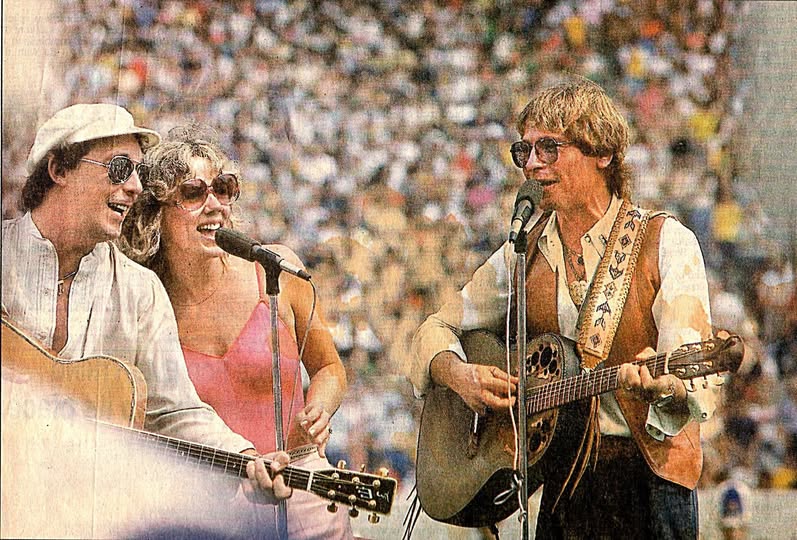
When the new Mountaineer Field opened, Denver returned to West Virginia alongside Danoff and Nivert to perform “Take Me Home, Country Roads” before more than 50,000 fans. Think about that for a moment. The very people who created the song stood in the middle of Mountaineer Field and watched an entire stadium sing it back to them.
That wasn’t an accident. It was an acknowledgment. By 1980, the writers understood something the critics still don’t: the song had taken on a life of its own.
Over the next four decades, the relationship only deepened. “Country Roads” wasn’t confined to football Saturdays. It was played at weddings, family reunions and backyard cookouts. It comforted people who had moved away and welcomed them home when they returned. Somewhere along the way, the song ceased being merely about the state and became part of what it meant to be from West Virginia.
Back home again
So yes, let’s tell the whole story.
Let’s acknowledge that Danoff and Nivert first found inspiration on a Maryland road. Let’s celebrate Denver’s vision to finish the song after a night at the Cellar Door. Let’s appreciate the artistry that transformed an unfinished idea into one of the most beloved songs in American music.
None of those facts diminish what happened next. If anything, they make the story even better.
For more than half a century, no people have embraced “Take Me Home, Country Roads” more completely than the people of West Virginia. It became the soundtrack of Saturdays in Morgantown. It welcomed freshmen to a new chapter of life and sent graduates into the next one. Denver himself stood in Mountaineer Field in 1980 and watched 50,000 fans claim it as their own. And for alumni, no matter where life has taken them, it remains the closest thing to a time machine ever written.
This summer, the rest of America got to witness that bond. ESPN let the moment breathe. NBC Nightly News celebrated it. The U.S. Men’s National Team sang it. For a few weeks, the country saw what West Virginians have known all along.
The writers gave America a masterpiece.
West Virginia gave it a home.
And after all these years, maybe that’s the only part of the story that really matters.

Fantastic! Great research and information… Thank you Mitch!
That was extremely, excellently noted!!