
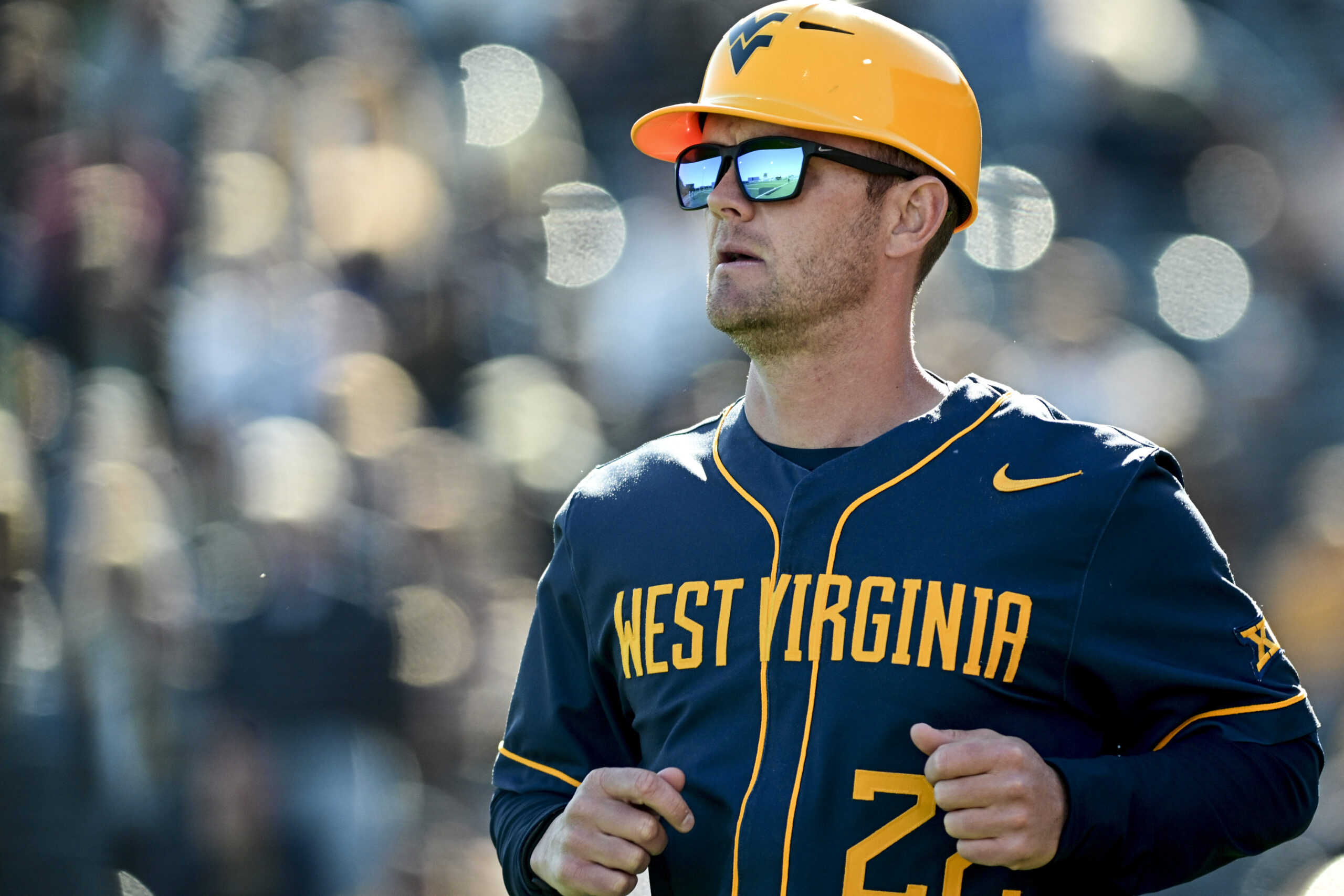
While it may have ended in disappointing fashion, Head Coach Steve Sabins exceeded all expectations in his first year at the helm of the West Virginia Mountaineers ball club. Read more: A Closer Look at Steve Sabins’ First Year as Head Coach at WVU
Sabins led the Mountaineers in a historic, up-and-down year that eventually came to a halt in Baton Rouge, where they lost in the Super Regionals to the LSU Tigers. That loss won’t define the first-time head coach in his quest to lead the Mountaineers to their first national championship.
Before we look to the future, let’s take a closer look at how Sabins fared in his first year in the skipper’s seat.
A Brief Overview
Sabins was hired to replace former longtime head coach Randy Mazey in June 2024. Prior to his promotion, Sabins had no previous head coaching experience. Other than serving as the associate head coach for the Mountaineers from 2022 to 2024, Sabins had only ever been an assistant during his coaching career.
That lack of experience drew concerns from fans and experts who had assumed the young, inexperienced Sabins wouldn’t be able to carry Mazey’s legacy. Flash forward a year later, and Sabins has put those worries to rest.
Sabins started his head coaching career by leading the Mountaineers to 13 straight wins, coming five games short of breaking WVU’s all-time record without a loss set at 18.
Related: West Virginia Women’s Basketball Learns Big 12 Opponents
He may not have stamped his name into the record books this season, but Sabins continued to lead the Mountaineers to impressive feats. He coached WVU to its second Big 12 regular season title with a 19-9 record in conference play. After a dominant showing in the Clemson regional, Sabins took the Mountaineers to their second-straight Super Regional—just the second appearance in program history.
The Mountaineers eventually lost to LSU in the Super Regional, but not before Sabins had already proven he deserved the role as head coach.
Replacing A Legend
When WVU Athletic Director Wren Baker hired Sabins, he tasked his new head coach with one of the toughest jobs in sports: replacing a legend. Having to replace a coach like Randy Mazey, who accomplished so much for the program, is an undertaking that no first-time head coach could possibly be equipped for.
Nonetheless, if you look at the 44-16 record in Sabins’ debut season to Mazey’s last season (36-24), you can see that Sabins wasn’t fazed by this task.
One area that improved under Sabins was the ability to get runners on base and capitalize on them. Under Sabins, the Mountaineers had a team batting average of .297, compared to .270 under Mazey’s final year. Sabins also instilled a more patient approach for his hitters. They drew 273 walks compared to 263 the year prior.
Related: Non-conference Showdowns Set for WVU’s Football Future
The Mountaineers also became more aggressive on the base paths as opposed to Mazey’s patented “Mazey Ball”. While Mazey was known for putting his runners in havoc-creating situations, Sabins one-upped him by recording 111 stolen bases this season, 23 more than the final year of “Mazey Ball.”
If you take all this into account, it’s no surprise that the Sabin-led Mountaineers scored 470 runs compared to Mazey’s 406.
The Pitching
Once Sabins took over, there was a lot of speculation about how the pitching was going to be handled. Mazey was a pitching guru known for keeping his starters in well over 100 pitches. While Sabins didn’t follow his predecessor’s approach, it was not to the detriment of his team.
This season, Sabins coached the Mountaineers’ pitching staff to a team ERA of 4.60, following a 4.98 the previous season. While execution improved, the biggest change under Sabins was how he used his pitchers.
Throughout his first campaign as head coach, Sabins regularly took out his pitchers early in their outings. Many times it was due to the pitchers putting themselves in bad situations, prompting Sabins to send out another arm.
Freshman flamethrower Bryant Yoak exemplified the strategy Sabins implemented. Throughout the season, Sabins called Yoak’s number 13 times, yet pitched only 5.1 innings. Cole Fehrman was another example of this strategy, appearing in 14 games with just 6.2 innings of work.
While some may disagree with this philosophy, the numbers show that it worked. Sabins and Mazey are on opposite ends of the spectrum when it comes to handling a pitching staff, but Sabins proved that his way can also be successful.
The Final Takeaway
Sabins led WVU through a wild ride filled with twists and turns. From starting 13-0 to experiencing mid-season skids, Sabins navigated the Mountaineers away from their historic 12-year stretch under Mazey.
Even after a disappointing end to the regular season, Sabins secured WVU’s first outright Big 12 regular season championship. He then handled his first taste of regional play with the performance you would expect from a seasoned coach, going 3-0.
Related: West Virginia Men’s Basketball Learns Big 12 Opponents
He achieved all of this in his first season as a head coach. Sabins used the doubts that had gathered around him after his hire and used them as fuel. Whether it was along the third base line or in the dugout, Sabins inspired his team with his gritty, tough personality.
That leadership is what propelled him in his debut campaign leading the gold and blue. He made his mark early, and despite all the adversities he and his team faced, Sabins came out with one of the best seasons in program history.
Sabins has created a new, exciting era for WVU baseball in just his first year calling the shots. If he can continue to grow and learn as a head coach, it won’t be long before he and the Mountaineers are catching a flight to Omaha, Nebraska, for the program’s first national championship.
A Closer Look at Steve Sabins’ First Year as Head Coach at WVU